
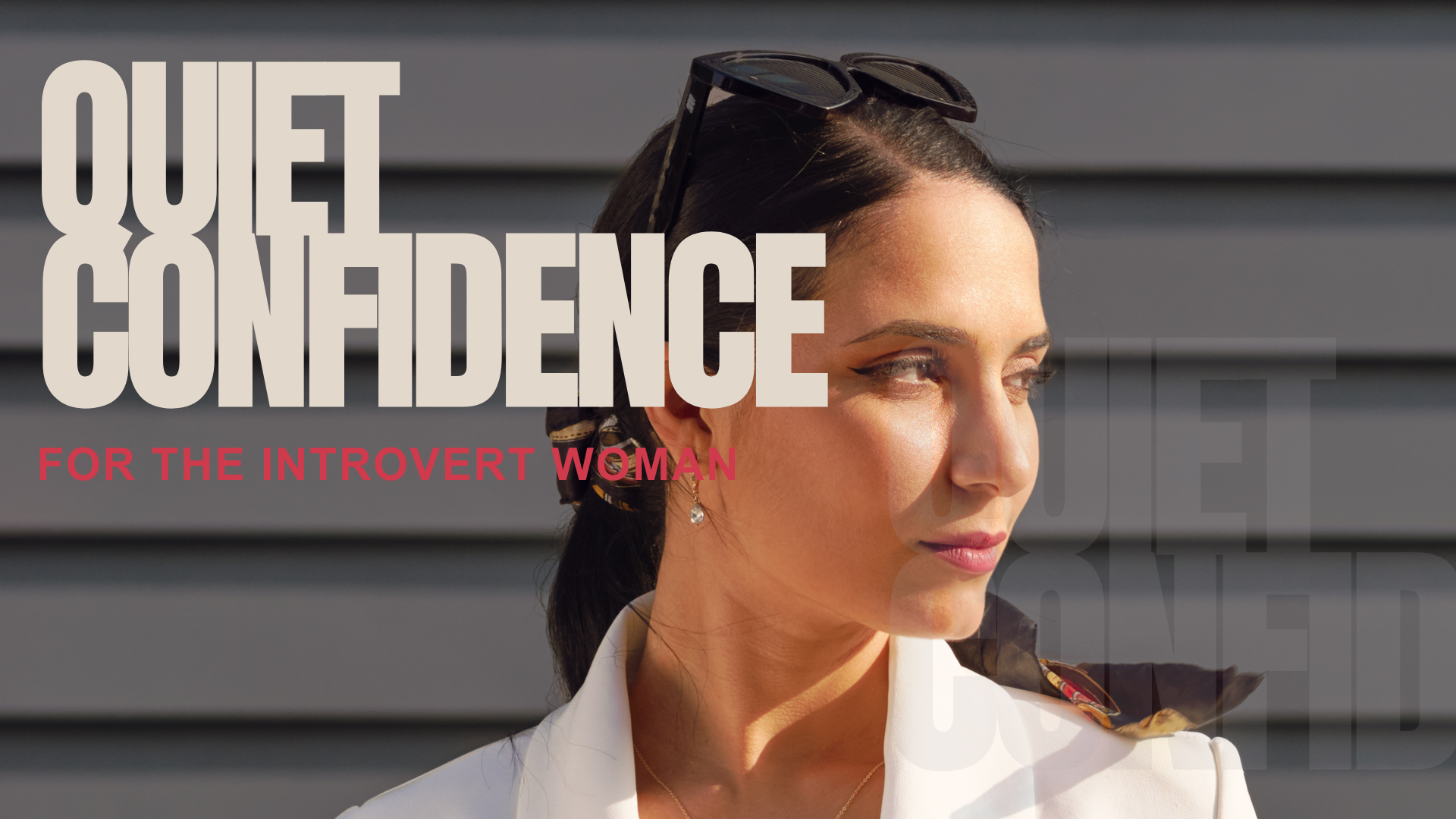
Quiet Confidence
An 8-week course for the introverted, high-achieving women.
Lead, speak up and be taken seriously, without becoming louder.
You’ve already proven what you can do. Quiet Confidence helps you finally trust the woman who did it, so you can stop freezing, over-preparing and replaying every meeting on the drive home.
You know these moments:
You’ve just watched someone else say a weaker version of your idea, louder, and get the nod.
You’re sitting in your car after the meeting, replaying the moment you should have spoken up, again.
You open your notes app to draft the email you’ve been avoiding, write three sentences, delete two of them, and close it without sending.
It’s the third time this week you’ve told yourself “next time I’ll speak up,” and next time hasn’t come yet.
If any of that just made your chest tighten a little, keep reading. This one’s for you.
Who Quiet Confidence is for
This is for the woman everyone relies on, who still doesn’t fully rely on herself.
You’re already good at what you do. You’ve got the results, the title, the trust of the people who rely on you. You’re a manager, a team lead, running your own thing, or one step away from it. You’re not new to leadership, and you’re not new to hard work.
But every time you have to be visible, defend a decision in front of higher-ups, speak first in a meeting, or put yourself in front of your own offer, something in you locks up. You feel like you’ll be ignored, that what you have to say probably isn’t smart enough, or that you have to become someone louder, more commanding, more “boardroom” just to be heard. So you either perform a version of yourself that drains you completely, or you freeze and stay quiet, and go home replaying it.
You’ve read the books. Watched the “find your voice” content. Maybe tried journaling, affirmations, power posing, a communication course. You’ve done real work on yourself. And you’re still asking, quietly, “Why does this still feel so hard?”
You’re ambitious. You’re not interested in playing small. You just don’t want to have to be the loudest person in the room to be taken seriously.
That’s who this is for.
What you're experiencing right now
You’re carrying real responsibility, and you’re still watching people who are less prepared than you get credit, get promoted, get listened to first, simply because they spoke up first or louder. Being “the reliable one” is starting to feel like it’s costing you opportunities instead of earning them.
Before anything with visibility attached (a meeting, a presentation, a launch), your body reacts like you’re about to be exposed, even when you’re completely ready. Tight chest. That low hum of dread. The kind of nausea that shows up no matter how good your results have been.
You over-prepare, rewrite your messages five times, soften every “no” into an apology, and still doubt yourself even when you’ve put in real effort. Afterward, whether it went well or not, you feel a little drained, a little fraudulent, and mostly just tired of managing how you come across.
And somewhere quieter, later, in bed or doing something as ordinary as laundry, you catch yourself scrolling instead of doing the thing you told yourself mattered. The thought that follows isn’t really about the scrolling. It’s “I did it again. Why can’t I just follow through? What’s actually wrong with me?”
Nothing is wrong with you. You’ve just been trying to fix the wrong problem.
Why "becoming more extroverted" isn't the answer
Almost everything you’ve been handed says the fix is to get louder. Take up more space. Speak more, post more, show up bigger. Power poses. Assertiveness scripts. “Fake it till you make it.”
You’ve probably tried some version of this. It worked for a day, maybe. Then you reverted, exhausted, because it wasn’t sustainable. It wasn’t you.
Here’s what nobody’s told you plainly: this was never a confidence problem. It’s an evidence problem.
You already have years of results. You just haven’t let a single one of them count. Every time something goes well, some part of you says “that was probably a fluke, next time it won’t go this well,” and the win gets filed away instead of building into anything. No amount of sounding more confident fixes that, because the performance is happening on top of an unresolved belief: I might be wrong. I might be found out. I might not actually be as capable as my results say.
Public speaking tips and power posing treat the symptom: how you come across. They never touch the cause: whether you trust what’s underneath. You can’t perform your way into trusting yourself.
Ready to work on the real problem?
What quiet confidence actually means
It’s not a quieter, gentler version of an extroverted leadership style. It’s not “confidence, but make it introvert-friendly.” It’s a completely different, equally legitimate way to lead.
It means saying less and having it carry more weight, because it’s actually true. It means making a decision and standing behind it without needing the room’s approval first. It means your calm reads as strength, not as something to apologize for. It means the person who leads your team and the person your closest people know are, finally, the same person.
Quiet confidence isn’t about becoming someone else. It’s about finally trusting who you already are enough to stop editing her down.
Why I created Quiet Confidence
I’m 73% introverted. And for years, I believed that meant I’d always have to fight myself to lead.
In 2025, I took over a business location with negative numbers and an unstable team, and led more than 30 people in my third language. I turned the numbers positive, built a stable team, and earned every single quarterly bonus.
And before every monthly meeting with my bosses, I felt sick. Every single time. Even when my results were good.
That taught me something I’ve never forgotten: being capable and trusting yourself are not the same thing. You can have every result to back you up, and still not let a single one count.
I didn’t change that by becoming louder. I changed it by understanding what was really happening in my body and my beliefs, and by learning to let my results finally count as proof of what I was capable of. That work changed my relationship with myself, and it became the foundation of Quiet Confidence.
It’s everything I wish someone had given me before that first meeting.
Imagine eight weeks from now
You walk into the meeting and say the thing, the first time, without rehearsing it in the car.
You defend a decision in front of the people above you, and your voice holds.
You send the email in one draft.
You say no without wrapping it in an apology.
A win happens, and instead of calling it a fluke, you let it count.
And for the first time, the woman who leads your team and the woman your closest people know are the same person.
Not louder. Not someone else. Just finally trusting who you already are.
Module 1, The Diagnosis. See clearly, for the first time, what's actually been happening, and why nothing else has fully worked.
Module 2, Reclaiming the Trait. Stop treating your quiet nature as the thing to fix, and start seeing it as the asset it already is.
Module 3, Self-Trust and Values. Rebuild the foundation everything else stands on: trust in your own judgment, separate from what earns approval.
Module 4, Nervous System Regulation. Learn to work with the freeze directly, the tight chest, the nausea, instead of white-knuckling through it.
Module 5, Owning Your Voice. Practice speaking and showing up from that trust, on time, without the pre-rehearsal spiral.
Module 6, Building Real Evidence. Learn to bank your wins as proof instead of dismissing them as flukes, so success finally starts to accumulate.
Module 7, Leading and Building Introverted. Apply it to your real team, your real business, your real rooms, in a way that's sustainable for who you actually are.
Module 8, Integration. This stops being something you're "working on" and simply becomes who you are, at work and everywhere else.
What you'll learn inside the eight modules
You don’t build lasting confidence by forcing yourself to speak more or pretending you’re not nervous. You build it by changing the relationship you have with yourself: what you believe about your abilities, how much you trust your own judgment, and what you do when doubt shows up. Each module builds on the one before it.
How it works
One module opens each week, for eight weeks. Each one builds on the last: the inner work first, the visible change after, so what you build actually holds this time.
Every module has 3–4 short video lessons and a workbook. Plan for 60-90 minutes a week for the videos and workbooks. With lifetime access, you can come back to any lesson whenever you need it.
What’s included
✓ All 8 modules, opening one per week
✓ 3–4 video lessons in every module
✓ A workbook for every module, so every lesson ends with something you can use right away
✓ Lifetime access to everything
Your investment
Founding price: €197.
After that, Quiet Confidence will be €297.
Doors open Thursday, 15 October 2026.
Quiet Confidence isn’t for you if…
…you’re looking for scripts to sound confident by Friday.
…you want to become louder or more extroverted. This course does the opposite.
…you’re not willing to do the workbook part. That’s where the change happens.
…you’re going through something that needs the support of a therapist right now. Please start there first.
Frequently asked questions
Yes. That’s exactly who it’s for. You can be capable, respected and successful, and still struggle to trust your own judgment or speak up under pressure.
I’m already successful. Is this really for me?
1
Yes. If you’re one step away from leading, building your own thing, or simply tired of staying quiet in rooms where you belong, this is for you.
I’m not a manager yet. Is this for me?
2
Are there live calls or a community?
3
No. Quiet Confidence is a self-study course, designed so you can do the work in your own time, in your own space. That’s part of what makes it work for introverts.
I’ve already read the books and tried other confidence techniques. Why would this be different?
4
Because understanding confidence and building it are two different things. Most techniques work on how you come across. Quiet Confidence works on what’s underneath: the beliefs that shape how you see your capabilities, how much you trust your own judgment, and what you do when doubt shows up. It’s not another set of tips to remember. It’s practicing a different relationship with yourself.
I’m shy, not introverted. Will it still help?
5
Quiet Confidence is built for introverted women: women who are drained by the spotlight, not necessarily quiet. If you’re shy and ambitious, much of it will still apply.
Because you get access to the course content as soon as you join, all sales are final. If you’re not sure whether it’s right for you, read through this page carefully, or send me a message on Instagram before you join, and I’ll tell you honestly.
6
Can I get a refund?
No, none of my courses are therapy. This is a coaching course: practical tools, self-trust and action. It doesn’t diagnose or treat any mental health condition and isn’t a replacement for therapy.
7
Is this therapy?
No. A new module opens each week for eight weeks, and you can work through them as they become available. With lifetime access, you can take your time and revisit any lesson or workbook whenever you need it.